How seed encrusting improves precision planting and agricultural yield
Seed encrusting improves crop performance by enabling optimal plant spacing. This reduces overcrowding in the field, which lowers disease pressure, protects young root systems and supports healthier, more uniform early growth. The result is stronger field performance and higher yield potential with less labour. In this article, Tomoko Sakata, senior research scientist at Incotec, takes a closer look at the benefits of precision planting and why seed encrusting has become essential for modern crop production.

What is seed encrusting?
Seed encrusting is a type of seed coating that gives the seed a smoother outer surface and improves its shape, size and weight. The components of the coating are carefully formulated to allow integration of products to protect and/or nourish the seed and seedling.
For small-sized seeds, encrusting is, in fact, the only effective way of getting the correct spacing between seeds.
Why use seed encrusting?
1. It allows direct seed application of protective and nutritional materials. This is made possible by the coating material, which is developed to allow integration of protective or nutritional materials so that they can be applied directly to the seed.
2. It makes the production processes more efficient. Encrusting seeds increases their size and smooths the outer surface, creating a more uniform shape. This makes them suitable for use in the mechanical sowing equipment making the sowing more efficient and cutting out the need for plant thinning.
3. It results in better field performance and optimal overall yield potential. Accurate seed spacing is achieved through mechanical sowing. For small-sized seeds, it is, in fact, the only effective way of getting the correct spacing between seeds. A direct result of sufficient distance between seedlings is that root health and development are much better than seen in seedlings in overcrowded conditions.
As the focus of this article is on seed performance and yield through precision planting, let’s dive deeper into this topic.
Benefits of precision planting
Precision planting is more than a processing step—it is a practical tool for better field performance and more sustainable crop production. To evaluate the benefits, we can first look at the damage that can be caused by planting seeds too close together.
The problem with high-density sowing
Sowing too densely is a common problem. Especially for small-sized seeds. Besides the issues listed below, any thinning process introduces an added risk of plant damage.
The issues caused by high-density sowing include:
• Stunted growth with plants competing for light, water and nutrients
• Higher disease pressure in crowded, humid conditions
• Weaker nutrition as roots fight for space and resources
Examples of problems experienced in common crops
| Crop | Problem caused by high-density sowing |
| Carrot | Thin or forked roots; damping-off; bacterial blight |
| Carrot/Lettuce | Sclerotinia; grey mould |
| Onion | Poor bulb sizing; grey mould and downy mildew |
| Spinach | Downy mildew |
| Finger millet | Higher risk of blast disease (yield losses can reach 20–40%) |
Having the optimal space between seeds, allows plants to establish at precisely the right distance from each other so there is no competition for resources in the root zone.
How thinning causes plant damage
Growers often rely on thinning to fix the issues encountered when seedlings develop in overcrowded conditions. The problem with that, however, is that when seedlings are sown in close proximity, the seedlings’ roots can become entangled. Thinning, which is already a costly, labour-intensive process and a burden for farmers, becomes the cause of severe plant damage.
Plant damage
Pulling seedlings out during thinning can cause irreparable damage to neighbouring seedlings. Wounds become entry points for soft rot and damping-off pathogens, and root and hair injury can lead to severe issues.
Examples of crop issues caused by root damage
| Crop | Issues caused by root/hair injury |
| Carrot | Forked roots |
| Lettuce | Slower early growth from hair injury |
How encrusting supports better yield with less labour
The benefits of encrusting apply equally to both bulk crops and high-value seeds.
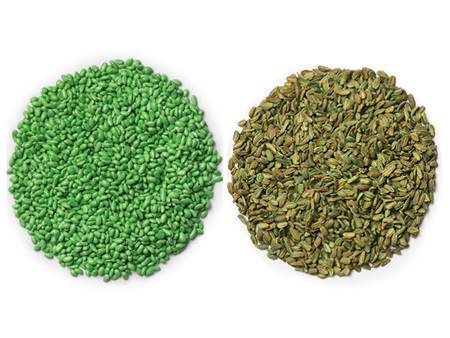
Encrusted carrot seeds (left) and untreated carrot seeds (right)
Precision sowing for plant health
By encrusting a seed batch, all the seeds are given a uniform size and shape, making mechanical planting, and therefore more precise sowing, possible. Precision sowing helps growers achieve better seed spacing from the start. Having the optimal space between seeds, allows plants to establish at precisely the right distance from each other so there is no competition for resources in the root zone. With no thinning step required, the root systems are protected from damage. Together these factors support healthier early growth and lead to an increased yield potential.
A cost-effective solution for small seeds
To illustrate the return on investment offered by encrusting let’s zoom in on small-sized seeds. The seeds of many crops are so small that they simply cannot be used in mechanical planters, so they are often sown manually. Their size and light weight lead to inaccurate metering, and difficulty maintaining the extremely shallow planting depths they require. Seeds end up far too close together and seedlings develop in overcrowded conditions making it almost impossible to thin them out. The outcome: severe developmental limitations. Encrusting offers a cost-effective solution by helping to:
• Reduce seed waste
• Improve crop performance
• Avoid thinning altogether
Finger millet yields in India, is a good example of how much can be gained when dense sowing is avoided. Standard yield using current cultivation methods is around 1.6–2.0 t/ha (ICAR-IIMR [Finger millet]), whereas the potential yield in the best cultivation conditions is >10 t/ha (ICRISAT) (Finger millet Dashboard). This indicates that finger millet typically achieves only 16-20% of its potential yield when sown using traditional methods. One of the reasons that the optimal yield is not reached, is high plant population. Wide row spacing leads to an improved number of panicles and productive stems, dry matter production, and light environment. Results show that the highest yield was achieved with 40cm row spacings (Getahun Dereje et al. 2016).
The additional benefit is elimination of the thinning process and a reduction of the number of seeds required. This is just one example that highlights the economic opportunity provided by investing in encrusting—even for low-cost crops
Encrusting – a practical crop solution
Seed encrusting is far more than a way to improve seed appearance or apply treatments. It is a transformative technology that addresses core agronomic challenges like precision sowing, disease management and yield optimization. For crops with small or irregularly shaped seeds, encrusting offers a practical solution to reduce labour, protect plant health, and unlock significant yield potential. It represents a step toward more efficient and sustainable agriculture.
Key Takeaways
• Seed encrusting improves yield because it enables precise sowing, which eliminates seedling overcrowding and thinning damage, and supports healthier plant development
• High-density sowing increases disease risk, leads to stunted plants, and can be harmful to root systems.
• Accurate spacing reduces seedling competition for light, water, and nutrients, supporting stronger early growth.
• Seed encrusting enables precision planting by giving seeds a uniform size and shape suitable for mechanical sowing.
• Precision planting eliminates the need for thinning, reducing labour costs and avoiding root injury.
• Small seeded crops benefit significantly, achieving more predictable spacing, less waste, and higher yield potential.
• Finger millet demonstrates the potential yield increases made possible through precise spacing.
• Overall, seed encrusting enhances efficiency, plant health, and yield, making it a practical solution for modern, sustainable crop production.
For more on seed encrusting visit Incotec Seed Encrusting.

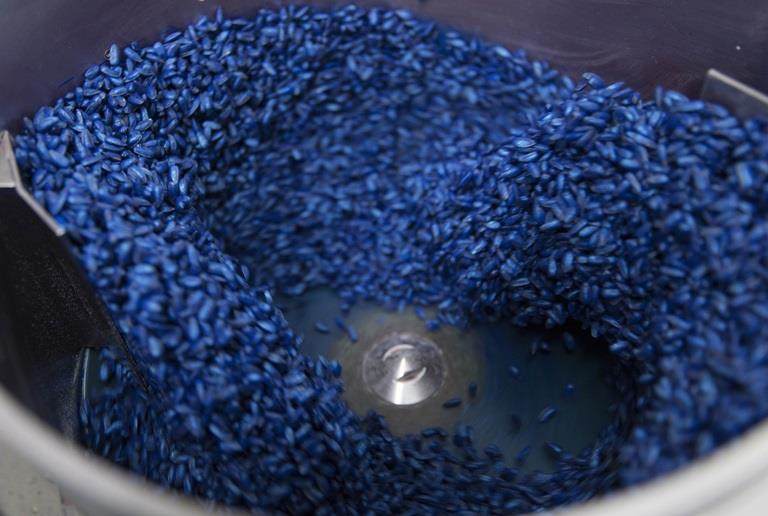
Seed encrusting

OPINION: 3 Ways that coatings with additional benefits contribute to sustainable agriculture in Asia
OPINION: Four factors affecting the shelf life of sweet corn seed
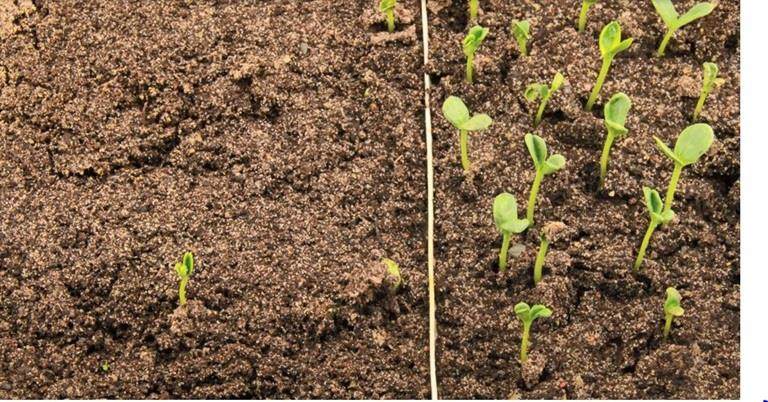
OPINION: Navigating germination challenges in Asia in a changing climate